Sunday, April 21, 2013

Catherine Creek - Wildflower Hotspot

4/20/13 - Started the day with lunch at the Solstice Wood Fire Cafe in Bingen, Washington (on WA Hwy 14) where we had a fabulous pizza with  morels, stinging nettle pesto, and goat cheese.  Stinging Nettles are edible if you smash them up or cook them, which destroys the stinging needles.  It was a mild tasting pesto, but good, and supposed to be full of vitamins.

 A few miles East of Bingen and
less than 1 mile West of Catherine Creek, we found these Artic Lupins Lupinus latifolius - by the side of the road. One (1) point.


And Barrett's Penstemon growing on a cliff face. This plant is endemic to the Gorge.  Any Penstemon is worth one (1) point.


At Catherine Creek, I walked through the lower area, which was carpeted with flowers.  Here is bicolored lupine - Lupinus bicolor.


I think this is Tomcat Clover - Trifolium willdenowii - rhizomes of native clovers were an food source for native peoples, dug out in the fall, after leaves had died back.
Camas (Camassia species - blue flower) and Meadow Death Camas (larger white flowers - Zigadenus venonosus)

Camas was an important food staple for native peoples, and Meadow Death Camas was to be avoided.  Camas  is worth 2 (two) points.


Shooting Stars (Dodecatheon species), pictured at left, were starting to fade, but still visible and worth 2 (two) points - I now have 28 points!

Friday, April 19, 2013

Western Gorge Flowers - 4/14/13 and 4/18/13

Looking East towards Crown Point 


It was a grey and rainy day in the Western Gorge, but there were flowers to be found just down the road. 


Stream violet- Viola glabella - blooms early and for a long time, this ground cover can be found in some lawns.


Pacific Bleeding Heart  - Dicentra Formosa - one of the most common flowers in the Western Gorge.  Seeds of this plant attract ants, who distribute them underground.


Larkspur - Delphinium species on the Flower Frenzy list for 1 point.  Just starting to bloom in Corbett, soon shady roadsides will be covered in these violet blooms.


Scouler's Corydalis - Corydalis scouleri - likes shady riparian areas, can be found along the trail around Latourell Falls.
Salmonberry - Rubus spectabilis -  also likes riparian areas.  
Sprouts and berries eaten by many native peoples.


Garlic Mustard, an invasive species just about to flower - pull it out! Leaves have a garlic-like taste and this plant was brought to North America as a garden plant.


Skunk Cabbage - Lysichiton americanum - large and smelly plant, attracts flies as pollinators - the flower head is the upright spike.  Skunk Cabbage is not a cabbage, but is in the Arum Lily family, as is the Easter Lily.


Hooker's Fairy Bells- Disporum hookeri - forms small orange-red fruits considered poisonous by most but were eaten by some native groups of Eastern British Columbia

False Solomon's Seal - Maianthemum racemosa - common ground cover in shaded forest areas.
Forms red berries that are edible, but not good tasting.  Resembles another plant that is the original "Solomon's seal".


Saskatoon also called June Berry - Amelanchier alnifolia -
highly regarded as a food and the wood also used for arrows, and digging sticks by native peoples East of the Cascades.


OSPREY!

Sitting in a Black Cottonwood next to the river, this osprey probably spent the winter in Mexico.  

Weisendanger Falls above Multnomah Falls

Tuesday, April 2, 2013

March Madness - 3/31/13


My own version of March Madness occurred on 3/31/13 while searching for more flowers on the Flower Frenzy list.  Near Shepperd's Dell (on the Historic Columbia River Highway a few miles East of Crown Point) I found Chocolate Lily (Fritillaria lanceolata) just about to bloom.  2 points on the list!


The same plant two days later


 Also at Shepperd's Dell a nonnative species - Honesty (Lunaria annua) common along roadsides in the Western Gorge.  Shepperd's Dell was donated to the City of Portland in 1915 by George Shepperd, a dairy farmer, and has a two-tiered waterfall in a narrow canyon.


And Sticky Blue-eyed Mary (Collinsia rattanii)
in the photo below -
 - both of these flowers are usually late spring bloomers, out early this year.  Shepperd's Dell is sheltered and shady, with many species growing on the rock face. Zacheus Collins was an early American botanist.


Columbia Windflower
(Anemone deltoidea)
A small perennial blooming earlier than usual.


The tiny, adorable Mimulus alsinoides - Chickweed Monkeyflower  - on the list - 1 point

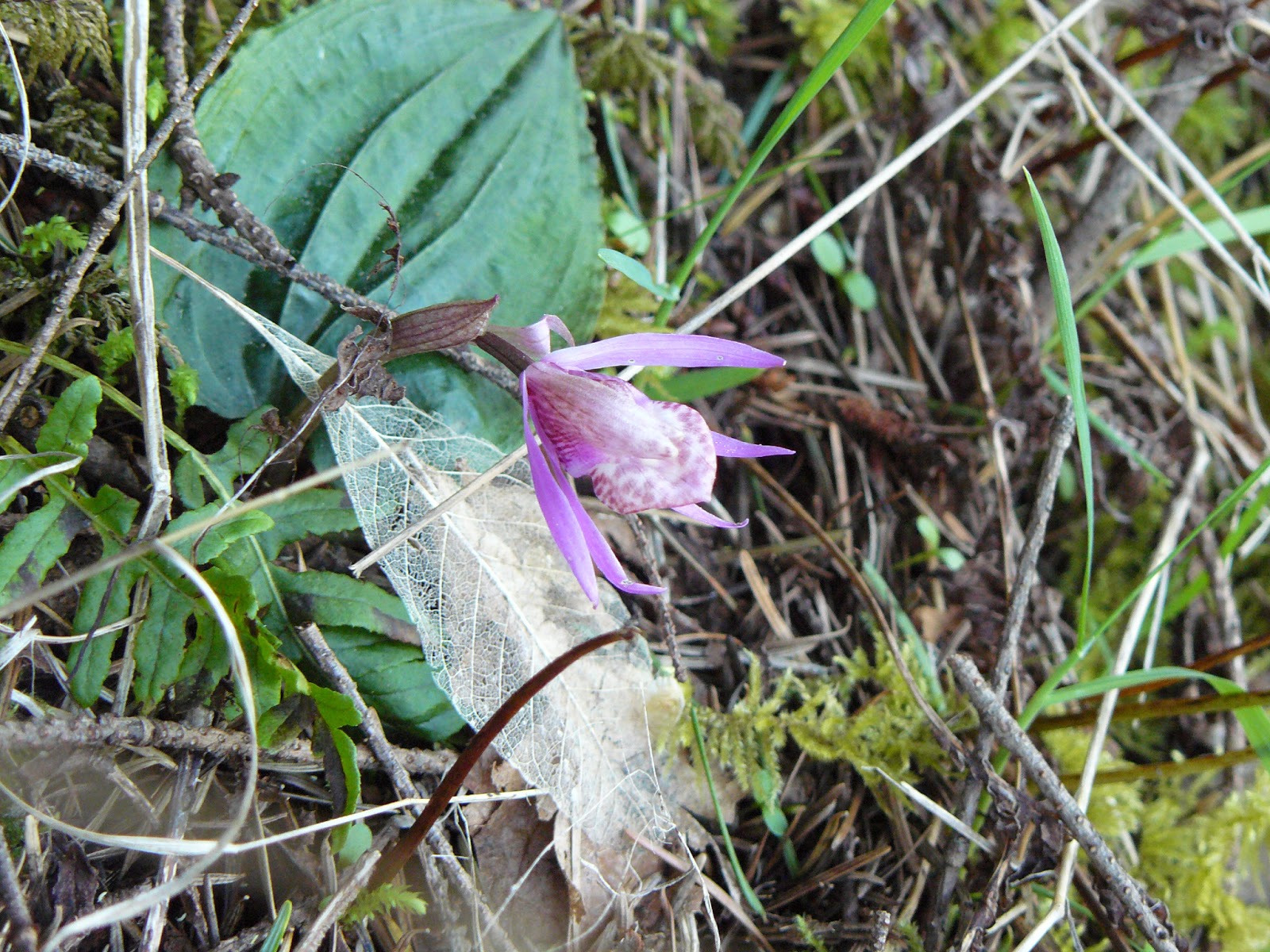
Along the road near Ainsworth - the rare and unexpected Fairy Slipper Orchid -  Calypso bulbosa - 3 points on the list!


Close by were Columbia Kittentails (Synthyris stellata) 3 points on the list!  This flower was new to me despite it blooming only a few miles from my house.


 Then on to the Twin Tunnels trail at Mosier (exit 69 on I-84).  Turn left as you come off the exit and wind up the hill to the Twin Tunnels parking area.  Glacier Lily (Erythronium grandiflorum) 1 point on the list - was blooming in the oak forest near the parking lot - look out - there's lots of Poison Oak here.  The corms (bulbs) of these lilies were eaten by some Native American tribes.


 Walking West toward the tunnel, at the base of the cliff, Miner's Lettuce (Claytonia perfoliata)was blooming in a moist area.  Leaves are edible - miners and European settlers used it.  John Clayton was another early American botanist.


In open sunny areas, Balsamroot is starting to flower - on the list, 1 point (Balsamorhiza sp.)


 Mr. Thornsby reappears on this blog after a winter vacation.  He is overlooking Mosier Creek in a clump of Columbia Desert Parsley.
A sparse forest grows up through an ancient lava flow.

 The end of the day at The Thirsty Woman pub in Mosier - a great place for a microbrew and a meal to celebrate a total of 12 flowers and 21 points from the Flower Frenzy challenge.

Saturday, March 23, 2013

Sunday, March 3, 2013

Wildflower Challenge 2013 - Catherine Creek

This flower is in the genus Saxifraga

     Friends of the Columbia Gorge have initiated a wildflower challenge this year, following the previous two years of hiking and visiting waterfall challenges.  Of course, I am all over it, being a fan of wildflowers.  There is a list of 25 flowers by species or genus to find between March 1 and July 31 this year.  If that is too many flowers for you, there is a point system so you can earn 25 points by finding fewer flowers.  Prizes, too!  I intend to find them all, and a lot of others as well.  More info at http://www.gorgefriends.org/flowerfrenzy
     I headed out to Catherine Creek in the Eastern Gorge,  which has a very high diversity of wildflowers in the spring and early summer.  At least 8 of the flowers on the Flower Frenzy list can be found there, although not all at the same time.  Go East on Washington Hwy 14 through Bingen, turn left on Old Highway 8 (4.5 miles past Bingen) and go about 1.5 miles to the parking area next to the road.  Trails go up and down hill from the gravel lot. 
Grass Widows, Olsynium douglasii
 Grass Widow (1 point) is blooming everywhere in the open areas at Catherine Creek now, but will soon fade and be replaced by other species.  Seen below,  Lomatium utriculatum, Fine-leaf Desert Parsley, is one of the other early bloomers at Catherine Creek.
Many of the Desert Parsley species were used as food or medicine by Native Americans


Lomatium piperi, Salt and Pepper
(2 points) a tiny plant but in the same genus as the other Desert Parsleys.  In the picture below you can see it dwarfed by a Grass Widow which is larger than life size on fullscreen.


This is a buttercup, genus Ranunculus, one of several similar species with bright yellow flowers
(1 point)

That is our nation's symbol flying above the hills in this photo,  looking NW from the parking area
Columbia Desert Parsley Lomatium columbianum endemic to the Gorge (3 points)
I have found 4 flowers on the list so far, earning 7 points!

Tuesday, July 10, 2012

Lower Oneonta Falls, Oregon 7/8/12

Columbine add color to the trailside
 From Portland, drive East on I-84 to exit 28 (Bridalveil), go East about 5 miles on the Historic Columbia River Highway to the Oneonta trailhead.  Take trail 400 to trail 424.  After about 1 mile, take trail 438 (Horsetail Falls trail)
down to the bridge where the falls are located.

Penstemon are also blooming now (the flower to the left is an invasive weed, Herb-Robert)

At the bridge, a view down to the Falls

A brave puppy crosses the bridge over Oneonta Gorge

Lots of big trees shade this trail - cool walking on a hot day
At the end of the day, a vivid sunset


Horsetail and Ponytail Falls, Oregon 6/27/12

 Take I-84 East from Portland to Exit 28 (Bridalveil) and go East 5.5 miles on the Historic Columbia River Highway. 
Horsetail Falls is probably the second most visited falls in the Gorge

It is right next to the highway, with a small picnic area and parking lot


 The parking lot is often full on warm summer days - go early (get there before 11 am) to find a space.  Closure of Latourell this summer (reconstruction of parking area) will push more people to this trailhead.  The trail is really not "more difficult".
About 1/2 mile up the trail is Ponytail Falls

You can walk behind the falls - great on a hot day!